
S3 E2–The Code We Live In: A Family’s Journey Through Hospital Design
Introduction
In this episode of Between the Lines with FGI, John Williams and Marissa Lamperis Kastrinos welcome back our beloved former co-host, Bridget McDougall, as she continues to navigate an unexpected and challenging chapter in her family’s life: caring for her 8-year-old son following the sudden onset of acute psychiatric symptoms. Bridget’s journey included repeated crises, multiple hospitalizations, and countless hours in health care spaces—giving her a unique, firsthand perspective on how the built environment can aid or hinder healing. While the conversation focuses on the intersection of the FGI Codes/Guidelines, design, and patient experience, we begin with a brief look at what led her family to seek care. Join Marissa, John, and Bridget as they explore why design matters in moments of vulnerability and how health care spaces shape recovery.
About Bridget McDougall
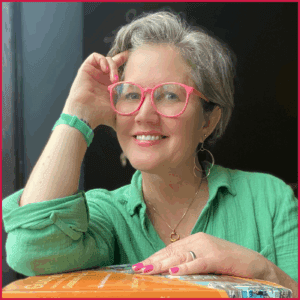 Bridget McDougall pivoted from long-term educator to full-time editor with FGI in 2019 after a chance encounter with FGI’s CEO at the time, Doug Erickson. Bridget found an immediate passion for working with, supporting, and learning from members of FGI’s Health Guidelines Revision Committee while simultaneously earning her editorial chops under the no-nonsense and equally supportive wing of Pamela Blumgart. Bridget’s insatiable curiosity about the stories that lie in between the lines of the codes can be heard in the episodes of Between the Lines with FGI she recorded, edited, and co-hosted with John Williams until passing the co-host torch to the ever-capable Marissa Lamperis Kastrinos. Bridget lives in St. Louis, Missouri, with her husband Rob, son, and a cat from several neighborhoods over who decided last winter that Bridget, despite never having (or liking) cats, is her new person. Bridget spends her time navigating several new worlds: cat owner (and liker) and caretaker to her unschooled 8-year-old son in the early and curious journey of autistic burnout.
Acronyms Mentioned
ADHD – Attention-Deficit/Hyperactivity Disorder
ASD – Autism Spectrum Disorder
ED – Emergency Department
GAD – Generalized Anxiety Disorder
OCD – Obsessive Compulsive Disorder
PANDAS – Pediatric Autoimmune Neuropsychiatric Disorders Associated with Streptococcal Infections
PBHU – Pediatric Behavioral Health Unit
PDA – Pathological Demand Avoidance
Mentioned in this episode
PANDAS resources
Aspire (www.aspire.care)
PANDAS Physicians Network (www.pandasppn.org)
PDA autism resources
PDA North America (https://pdanorthamerica.org)
PDA Society (www.pdasociety.org.uk)
At Peace Parents (youtube.com/@atpeaceparents)
Transcript
Download the transcript here, or scroll to the bottom of this page for a quick view.
Earn CEUs Anytime with FGI University and Between the Lines with FGI:
Did you know you can earn continuing education units (CEUs) just by listening to Between the Lines with FGI? It’s simple! Head over to FGIUniversity.org, our educational platform for the FGI Codes/Guidelines, and explore CEU- and HSW-approved audio courses designed to make earning credits effortless—perfect for learning on the go. To make it even better, use promo code BTL10 at checkout to get 10% off any Between the Lines with FGI course. Listen, learn, and save today.
Sponsored by
 American Society for Health Care Engineering (ASHE): Optimizing health care facilities




Don’t forget to share with your friends and colleagues!

Special thanks to Neal Caine and the Neal Caine Trio for the use of his song “Skip To My Lou” by the album of the same name.
Find the album on Spotify or Apple Music.
Visit Neal Caine’s website here.
Season 3 Episode 2 The Code We Live In: A Family’s Journey Through Hospital Design
—Transcript—
Intro
[00:00:00] John Williams: Hey, Between the Lines listeners. A quick intro to this episode before we get started. Many of you have noticed the absence of my regular co-host Bridget McDougall over the past year, and you, like us, have really missed the contributions, the levity, and just the pure joy that Bridget brings to this podcast.
Starting January of this year, Bridget had to unexpectedly pivot away from us to focus on the care of her eight-year-old son after his sudden presentation of some acute psychiatric symptoms. During this time, Bridget has spent countless hours in many of the spaces that we describe both on this podcast and in the FGI Code documents.
So, she has had some firsthand understanding of how the health care environment can either aid or hinder healing.
Marissa and I are really glad and grateful to have the opportunity to sit down and talk with Bridget today about her experience. And while the focus of this episode is gonna be about the built environment and the patient experience, we thought it might be helpful just to give you a really quick understanding of what led this family to seek care for their son in the first place.
So, Marissa’s going to read something about that from Bridget herself. Marissa?
Where has Bridget been?
[00:01:12] Marissa Lamperis Kastrinos: Thanks, John. Before January, outsiders looking in on the day-to-day life of the McDougalls would see a typical family with a typical kid. After January, however, a period of repeated crises and escalations that continue to this day was marked by a sudden change in her son’s behavior. Help was immediately sought out when symptoms started arriving at a dizzying pace.
Those symptoms included motor tics; vocal tics; debilitating anxiety; OCD; intrusive thinking; extreme separation anxiety; sleep disruption; regression in reading, writing, and math skills; and aggressive and dangerous dysregulations that threatened the safety of everyone in the family. Now, I’m a numbers person, and looking at the numbers of their experience from January to now is startling.
There have been eight hospitalizations, 12 calls to 911 from home, school, various public places. There have been seven referrals to specialists. Three separate repair calls for broken windows. One shattered laptop, two damaged vehicles, one hotline investigation. 20 different medications prescribed 56 times. There have also been five diagnoses that read like an encyclopedia of acronyms. OCD, ADHD, GAD, ASD, and PANDAS. And none of these individually point to the dramatic change that was seen in Bridget’s eight-year-old in January.
Enter ASD: Autism Spectrum Disorder, and a specific profile of autism called Pathological Demand Avoidance, or PDA. PDA presents atypically compared to more widely understood autism. For example, PDA kids tend to maintain good eye contact and seek social engagement. Those with PDA autism usually escape traditional diagnosis until they reach what is known as PDA burnout.
It’s then that the kid goes from seemingly capable to completely debilitated almost overnight. Such was the case with her son.
Now layer on Pediatric Autoimmune Neuropsychiatric Disorders Associated with Streptococcal Infections, or PANDAS, and you have the combination of complex diagnoses that turned the McDougalls’ household on its head eight months ago. PANDAS can also be responsible for sudden onset of severe psychiatric and neurological symptoms in kids.
There is a lot to untangle here, and each facet is deserving of its own podcast episode deep dive. However, that is not the scope of this podcast. We go between the lines of the Code to explore intersection of the Code, genesis, and patient experience, so please enjoy this conversation that we have with Bridget.
And if you’d like to know more about PDA autism or PANDAS, be sure to see the resource links that we provide in the show notes. Now, on to this episode of season three of Between the Lines with FGI.
[Intro music: “Skip to My Lou” by Neal Cane Trio]
Sponsorship
[00:04:45] Bridget McDougall: This episode of Between the Lines with FGI is brought to you by the American Society for Health Care Engineering. Optimizing health care facilities.
Opening
[00:04:57] Bridget McDougall and Marissa Lamperis Kastrinos: Welcome to Between the Lines with FGI—
[00:05:02] Bridget: Uh, wait—
[00:05:03] Marissa: Wait, what am I hearing—
[00:05:04] Bridget: Uh, Marissa?!
[00:05:06] Marissa: Bridget, is that you?!
[00:05:07] Bridget: Is that you?!
[00:05:08] Marissa: Oh my gosh!
[00:05:08] Bridget: Oh!
[00:05:09] Marissa: Bridget!
[00:05:10] Bridget: Hey!
[00:05:11] Marissa: Yes!
[00:05:13] Bridget: How are you?
[00:05:14] Marissa: Well, I’m amazing now, Bridget!
[00:05:16] Bridget: Oh!
[00:05:16] Marissa: You came at the perfect time; we are literally recording Between the Lines with FGI right now.
[00:05:22] Bridget: OK, here’s what’s crazy. I—I knew that I was asked to come on and talk a little bit about the intersection of what’s currently happening in my life as a mom, and the built environment, and the Guidelines, but it’s like I got behind the mic and I thought I was co-hosting for a second. It’s like, it’s so ingrained in me. I forgot I’m on the guest side today.
[00:05:41] Marissa: I mean, you were born to do it, so it makes total sense. But on that note, would you mind kicking us off?
[00:05:47] Bridget: OK, so the honors, I’m happy to do it. Here we go. Welcome to Between the Lines with FGI, a podcast brought to you by the Facility Guidelines Institute.
In this podcast series, we invite you to listen in on casual conversations related to health and residential care, design, and construction. Joining us today is FGI‘s very own John Williams, vice president of content and outreach, and chair of the 2026 Health Guidelines Revision Committee.
[00:06:17] John: And joining us today is Bridget McDougall, beloved associate editor with FGI, and Marissa Lamperis Kastrinos, FGI’s brand-new education director. And we’re here as always, because we’re curious about the health care built environment.
[00:06:33] Bridget: That’s right. And this is, uh, gonna be an interesting episode to record.
[00:06:39] John: I’m out.
[00:06:39] Bridget: He’s out. We’re gonna get to a lot of good stuff today, but, um, so Marissa?
[Music fades out.]
Why Bridget?
[00:06:47] Marissa: Bridget?
[00:06:47] Bridget: I have a question for you. Why did you all decide to ask me on as a guest? I’m honored. Why is that?
[00:06:54] Marissa: We really wanted to, first of all, celebrate how core you are to Between the Lines with FGI. We were so excited, first of all, to get some quality time with you and bring you back to your roots of being on the show, but also, we really wanted to learn more about your day-to-day. You’re still doing incredible work behind the scenes, but now you’re also spending a lot of time in the spaces that you are editing content about.
[00:07:20] Bridget: Yeah. Let me just say it continues to be such an honor to be involved with FGI. I have gotten to spend time talking to people and really understanding the impact of these Codes and, and the stories behind them.
I wanna know what’s happening. How, what’s the origin? What does it look like in practice? And, um, and every guest we’ve had has taught me something invaluable about health care spaces. For those that don’t know, I—our family and me, specifically speaking to the role, my job—um, really had an emergency pivot beginning in January from just full-time living, breathing FGI work, which I love, to really almost full-time caregiving to my eight-year-old son. I can tell you that I do believe that we’re starting to understand what’s happening and, um, and I’m happy to talk about that. I appreciate when people, you know, have sensitivity around it or wanna be respectful.
I’m an open book. I always have been. I, not only is that a space where I’m comfortable, but I truly believe that, um, if this helps anybody look at building their environment differently, or if it helps clinicians think about the patient that’s walking into the room differently, or if it helps families, um, that might be like ours, have hope for an experience they may have, um, then it’s totally worth it to me to be here. So, I’m grateful to be able to talk about the intersection of our experience and the environment in which we’ve been seeking treatment.
[00:09:08] Marissa: I’m glad that you’re open to sharing this with our audience, sharing it with us, and shedding a little bit of light on something that you mentioned is very rare and, and popped up unexpectedly in your world.
Unexpected hospitalizations and receiving diagnoses
[00:09:17] Bridget: I can say this. Um, I was 44, uh, when I had a full-term healthy baby, miracle baby. Everybody was like, “Holy cow.” You know? This—and from the get-go—this kid was hilarious and different in all the ways that I love. So, he was not your cookie-cutter kid, although he from afar probably looked like it. Um, but there always was something about, you know, this kid’s wild, wild bright and wild engaged and social and like a, like a, just a high-speed train going through our life, but with joy and constant interests. And so, you know—he—he did things that looked like other kids, but he is so intense in everything that he does. And I don’t mean intense like serious, I just mean like every interest he has had, it’s full-on. I share all this to say: in January, when we had this acute presentation of symptoms, it’s not like there were no signs before then that there was a “there” there.
But in January, we had, all of a sudden, a situation where our kid started wetting the bed. He was, had OCD that just present—that was debilitating for him. Worried that he wasn’t gonna have access to water, constantly worried that he would be locked somewhere without water. Um, uh, meltdowns that were huge. It was, I was unable to get through a conference call at work without him absolutely blowing his stack, like just going from zero to a hundred in, I couldn’t tell where it was coming from. Um, the first time in January, we had this like seven-hour long dysregulation. We ended up at the hospital.
So that first hospitalization, [he] was diagnosed with OCD/ADHD combined type, Generalized Anxiety Disorder, um, and then in the subsequent hospitalizations that each kind of ramped up with, um, severity of danger and safety, he was also diagnosed with Autism Spectrum Disorder. He was diagnosed with PANDAS, which stands for Pediatric Autoimmune Neuropsychiatric Disorders Associated with Streptococcal Infections. After, there was a correlation between the incredible number of strep infections that he had and a sudden presentation of symptoms, um, neuropsychiatric symptoms.
So, this kid has a nervous system disability, you know, and is treated with, um, getting that nervous system calm and safe. And so that’s what I’ve been doing recently is basically, uh, acting like his external nervous system. So, like somebody who can’t breathe and needs an iron lung with them, and he is requiring me as his safe person to be his co-regulator all the time.
Maybe I can give you some list of books or links in case people wanna look more into it. This is not a podcast about PDA autism or PANDAS. You know, this is a podcast about FGI and the Codes that, and the process of the Codes and the stories between the lines of those Codes. And I am one of just millions, I could say, probably, of examples of people who have stories of being in facilities that are impacted by these Codes.
[00:13:11] John: You know, Bridget, I know for folks who are just hearing this for the first time, that’s gonna be a lot to digest. And I know that there’s a lot of folks out here who really enjoy hearing you and all the folks in the community who know you. Um, I’ve heard more than once from folks wanting to reach out and connect with you and, you know, support you. And I—I hope that you feel that from all of us, and [I] just am so thankful that you’re being such a great mom and so thankful that you’ve made time to share with us.
[00:13:49] Bridget: You’re right, John; that’s a lot of information to receive. I’m also aware that we don’t know the stories of everyone who might be listening to this, and we all have stories. So, there may be listeners who have similar things happening in their own home.
Experiencing facilities while in crisis: Quiet room and emergency department intent versus design
[00:14:08] John: So, Bridget, you, you talked about how people encounter facilities and how people move through them, especially people in crisis. What was your experience?
[00:14:18] Bridget: I would say, honestly, if you’re talking about a behavioral and mental health patient, I would make a pin in episode five, was it, with Scott Zeller?
[00:14:30] John: Mm-hmm.
[00:14:30] Bridget: Truly, truly, we cannot have this episode without going back and listening to that, um, because he really dives into spaces that are used for treating folks that are in behavioral mental health crisis, and the genesis of those spaces and what’s really needed. And having been in them now, I cannot agree more with what he talked about. And it’s really that pivot from treating people like they are, I mean, I hate to say it. I—I understand there’s a safety component, especially if you have somebody who’s presenting with violent symptoms. And our son certainly was, and would, well, he would pivot in and out of it very quickly.
So, this is the same kid who—let me give you an example—he was in an inpatient facility here. This was hospitalization number three or four, I think. But his first long-term inpatient. And, on day two we got a call from the psychiatrist of this hospital and he said, “You know what? I just wanna tell you, he’s doing great today. He’s like, he’s hilarious. Everybody knows him up here. He’s talking to all of the staff. He’s talk— he’s engaging with everybody. He’s—” and yeah, that’s our kid. Like, that’s him. He’s, and he said, “So I just, I really feel like he’s stable and, and could probably be ready for discharge.” So, when he said, “He sounds great, he’s doing well.” I’m like, “OK, well that’s, that’s good news. I, you know, I prefer if we just give it a day or two.” That was my polite way of saying, you mess around and find out.
At two o’clock that morning, I get a phone call from the hospital. I hear my son screaming, just screaming in the background and they are explaining to me that, you know, he became upset because he couldn’t call me. They wouldn’t—it was two in the morning—they wouldn’t let him call me, and he proceeded to, you know, flip furniture and try to rip the phone from the wall, and that they had chemically sedated him and he—with an injection—uh, because he refused to take the pills, and they put him in a quiet room, uh, for the evening.
I had been to that facility for the visiting hours, which I, we were allowed to see him for a two-hour stretch once a day. And the quiet room, you know, again, this is where you get to the Code versus what it looks like in real life, because we say in the Guidelines about how this space has, if you have to have ‘em or not, how the—I believe we talk about square footages, surfaces, those kind of vision panels, being able to see the patient, right?
[00:17:26] John: Mm-hmm.
[00:17:26] Bridget: But that’s the framework of the space. Then layered on top of it is the design choices, right?
[00:17:38] John: Mm-hmm.
[00:17:38] Bridget: What does it actually look like? And then layered on top of that is the operational aspect. How are you using this space? How are folks being trained to engage with the—the patients who are receiving care in this space? So, a quiet room can be anything from that therapeutic place to help—oh my God, and if he had had access to a space like this, how amazing that would’ve been—but a therapeutic space to help someone who is dysregulating because of a nervous system, uh, fight, flight, or freeze, being able to really feel calm, supported, safe. And I am understanding and seeing when he feels that way, the aggression is not present. But instead, somebody who’s experiencing a panic attack, basically, that’s exhibiting itself in violence.
The quiet room I saw was, it was all gray. It had a what, one bed bolted to the floor. It was small. I don’t know what the minimum space is, but just big enough for the bed and maybe a couple feet on the left, right, and foot side. A solid door. What seemed to be like the size of a—an envelope—piece of glass in it where you could look in and see the person.
And my seven-year-old slept there overnight in a drugged state because of the chemical sedation. And that was the first time he had spent the night away from people he knew.
So, it’s one thing to think about these spaces when we read about them in the Guidelines. It’s another to think about it when you’re building a facility and talking about, can you afford the square footage? Do you need it? Do people use those spaces?
And I know that we do not address operational aspects in the Guidelines. We say it time and time again. And it’s true, it’s not our place. There are other things for that, right? But our experience is that what we imagine, what we would want for anyone, let alone our child, the care spaces that we encountered for behavior, behavioral, and mental health. Um, actually, I continually thought about how do people take an oath to do no harm and then treat people in crisis in spaces that end up causing more harm and trauma than what the person came in for?
[00:20:20] Marissa: Uh, for something like this, that is an interaction that is so important. I mean, it really shapes your experience.
[00:20:30] Bridget: It does. I wish that we, what we encountered was more akin to what Scott Zeller talks about in that episode five, with the EmPATH model, and it just wasn’t. And I have compassion for all the intersections here that health care workers, really, there’s a safety aspect there. I get that. I mean, it’s scary. And he’s eight, you know, I mean he’s like a hundred and something pounds now, what if you have a grown person, what do you do? And I understand that. I also get that, if somebody’s handcuffed in a room where they have a sitter, that’s not therapeutic. And there are a lot of needles that need to be moved. Both in the built environment and also the operational arena to really care for people properly that deal with diagnoses that present in behavioral and mental health symptoms.
Another experience that we had was, uh, arriving at the emergency room via ambulance with, again, our seven-year-old child, and the pediatric side of the emergency room was full. So, they placed our kid in the—the adult emergency psych unit. The room itself was not at all conducive to any kind of behavioral/mental health patient or visitor, let alone a child. I think that’s the thing that, that was so heartbreaking for me, as someone who is on this side of it with the Code and then on that side of it as the patient, is I know the intent of the people that help write these Codes. I’ve never met people that are more passionate about the patient experience, about being in this line of work for the right reasons, which is really taking care of patients and making sure that it’s safe, to go and see it in real life, and see that something wasn’t translating between what the intent is and the care and the passion and our experiences. And I—I mean, you know, that’s a mammoth thing to unpack, right?
A positive difference: Support areas for families, patients, and visitors
[00:22:39] John: Bridget, can you help us walk through a space maybe where, um, you experienced something that made a positive difference?
[00:22:46] Bridget: Let’s talk support areas for families and vi-visitors. What do we say?
[00:22:52] John: Support areas for families, patients, and visitors.
[00:22:55] Bridget: That’s it. That’s the one. Yep. We spent a lot of time in the pediatric behavioral health unit is what they call it, uh, there, it is the PBHU. And um, and I saw in those spaces, I noticed it. I walked around the weighted furniture that you couldn’t throw. It was really nice, too. Like it was just smooth, nice looking. Um, everything was clean. The way that the TVs were behind glass. I was looking at ligature resistance. We just can’t see these spaces the same. It’s kind of like once you wait tables, you’re always gonna tip well, you know? In the, the PBHU, we didn’t have access to family support areas. It was like, you’re on your own, ‘cause they considered it part of the emergency room. So, I guess a lot of people are meant to come in and out, but we would spend sometimes four or five nights in this pediatric behavioral health unit, which is really meant as a holding place to stabilize the patient and then move them on home, or send ‘em off to an inpatient. Well, talking about family support areas, um, they didn’t have areas like that. There was a conference room down the hall we would use to talk to people. There was a bathroom, a public bathroom, and that’s where I would wash my face and brush my teeth. And that was it.
Well, when he was admitted to a floor, a whole new world opened up for me. I was told, hey, we have a family, it’s like a family center or something. So I went there and I walked in the door, and when I walked in the entry of this family support center, I’d looked around and I saw an open kitchen space that was fully stocked, tables with little flowers on each table, and napkins, and hand sanitizer, and I saw couches with TVs in a separate area. I saw a desk with three people sitting there ready to welcome me. I saw a business center area with computers and a printer. I saw a room with the lights all low, with, like, recliners in there and dividers in between. I saw a sign about showers and laundry facilities, and I stood there and I took it all in. It was the first time in all of our experiences where I felt like we were seen and care was there for us.
It didn’t matter what our diagnoses were, uh, what we had been through. It didn’t—we didn’t have to convince people to believe our story. And so, it was the most beautiful intersection, and, um, the woman came around and gave me a big hug and just said, you know, “You deserve this,” and “You— we— we’re happy to be here for you,” and “This is why we’re here.” And she said, “A couple years ago, we didn’t have this. We had nowhere for families to go in this hospital.” She’s like, “This is new.” And she took me on a tour of it. I took a shower, I cleaned clothes. I just—I couldn’t believe it. And what that did for me as the caregiver, I was able to then return to my son who was in his room, and my battery had been filled enough that I could continue to care.
So, I—hands down, if you get anything out of this episode, it is: push for not just adequate support spaces, but support spaces that really make a difference in the life of the families that are coming. It was incredible.
[00:26:27] John: There, there was another time I remember you telling me this, um, about you were in a pediatric section of, of a behavioral health emergency department, I think it was, and it was laid out in a way that supported you. Do you remember that?
[00:26:42] Bridget: The entrance to the ED . . .
[00:26:44] John: Mm-hmm.
[00:26:45] Bridget: . . . That was really focused on pediatric, a pediatric entrance to the ED. Yeah. I mean, we have walked into emergency rooms where they’ve been packed, and people on gurneys in the hallways, I had never seen anything like this. Patients outside, patients inside, noise, people crying, people, you know, obviously this is a place that is filled to capacity, right?
[00:27:11] John: Mm-hmm.
[00:27:11] Bridget: And you can’t fault anybody for that—it’s just how it was—but I look at these kind of spaces, and to walk into an environment like that and not have the ability to escape it is, uh, really rough. If it’s loud and echoey and all of that is exacerbating, then operationally at least, do you have noise canceling headphones? If you have somebody that comes in and needs a walker, you understand that they need a walker and need assistance. But when somebody comes in and they physically look typical, but have needs that are really acute, not only does that harm the patient’s ability to possibly get care, but also the, the care provider’s ability to treat that patient.
Recommendations for designers
[00:27:55] Marissa: Yeah, I can definitely see what you’re saying. So, if you were to talk to facility managers or designers, what kind of recommendations would you give that you think could help others in a similar situation to you with having a better experience in these spaces?
[00:28:11] Bridget: Our situation could specifically be helped by understanding the profile of autism that is PDA, period. And I think that’s our biggest hurdle in our story, and that would have gotten us like, 70 percent up the mountaintop of recovery.
[00:28:33] John: Right.
[00:28:34] Bridget: And then there’s the rest of the 30 percent where there is still plenty to talk about, about what could be done for all patients, right?
[00:28:42] John: Right.
[00:28:42] Bridget: But um, the space that was connected to the ED, and again, I understand this is meant to be a very short-term space, but for, for us, it was not. It is like a—a place devoid of time or reason.
[00:28:59] John: Mm.
[00:28:59] Bridget: There are no windows, and having spent many days there in a row, I couldn’t tell you if it was morning, afternoon, or night.
[00:29:09] John: Wait a second. You—this was in the emergency department?
[00:29:12] Bridget: Yes, but no windows, you know?
[00:29:15] John: Mm-hmm. And, and how long were you in that space, with no windows?
[00:29:18] Bridget: Um, I mean, we did it multiple times. I would say maybe four night—five days, four nights?
[00:29:25] John: And you had no orientation to daylight—
[00:29:28] Bridget: Correct.
[00:29:28] John: —what time of day it was, whether it was raining, sunny, night.
[00:29:32] Bridget: Correct. And remember, because these—the emergency space is not meant to be therapeutic. They’re not meant to receive treatment. They’re meant to be evaluated and stabilized, so there wasn’t even, like, a routine to depend on where you do X at this time and X at this time, and you look for, you could judge your day by what activity you were doing. There was a TV in the room, and then you could come out to that common area, but only one patient could be there at a time. So, you had to, you know, spend your time wisely and share it with other patients.
[00:30:05] John: Right. Did you notice any impact by not being able to see daylight?
[00:30:09] Bridget: It’s very depleting. It’s disorienting anyway, to have your kid in the hospital. The environment is so important.
[00:30:16] John: Well, I think probably the most common approach is to say, if you’re gonna put people in a space for a really long time, make sure it’s on an exterior wall, and have that access to light. And if you have a space inside of a building where that’s not there, that’s not the best place for a patient to stay for a long time.
[00:30:37] Bridget: There you go. That’s what it is, right? Because a space with no windows is perfectly acceptable for all the different types of spaces you might have in a hospital.
[00:30:48] John: Exam space, short-term.
[00:30:49] Bridget: Storage spaces, yeah.
[00:30:49] John: Yeah, if—if you have a requirement, then we can hold people accountable. But if it’s a recommendation or it’s a design option, we can have the conversation, but—
[00:31:01] Bridget: Right.
[00:31:01] John: —we don’t really have the teeth to enforce anything.
[00:31:03] Bridget: Yeah.
Wrap-up
[00:31:04] John: Bridget, thank you so much for—for doing this, and I—I really appreciate it.
Bridget, we talk about spaces, and we talk about caring about people, and we talk about—it’s all about the patient. It’s all about the patient. And I think, certainly we’ve all had people who are patients before in our lives, and it just becomes different. It becomes personal, and you get invested. And I—I—I think if we can keep reminding ourselves of these stories, that’s why a lot of us are here. We do it—we do it because we love it. Not only is it about the patient, but we know the patient and the patient is us.
[00:31:39] Bridget: Yeah. I really appreciate the opportunity to—to come and—and talk with you all and explore these intersections, and . . . I know where your heart is, both with me and my family and with the people that these Codes and documents impact.
[Intro music: “Skip to My Lou” by Neal Cane Trio]
Outro
[00:32:00] Marissa: Bridget, thank you for sharing your story with us, and listeners, thank you for joining us for another episode of Between the Lines with FGI. Do you have an idea for an episode, or are you interested in sponsoring one or a series of episodes? If so, we’d love to hear from you. Get in touch with us by sending us an email at podcast@fgiguidelines.org.
Stay tuned for our upcoming episodes in the new year where we focus on the highly anticipated launch of the 2026 FGI Codes for Planning and Design.
Looking for a sneak peek? Check out FGI University, our new educational platform filled with diverse content on the Codes and Guidelines, including insight to the 2026 launch.
John, I promise you I’ve prepared for this episode, but I have to say, some of the terms and words that we used are so outside of my vocabulary, so I felt like I was stumbling over my words this entire time. Like streptococcal.
[00:33:06] John: Yes. That’s a hard one.
[00:33:07] Marissa: Yeah. I’ve n—I’ve never heard that term before this episode, so I’m, I’m still trying to find my groove with pronouncing that one.
[00:33:14] John: Strep throat, but don’t feel bad.
[Music fades out.]